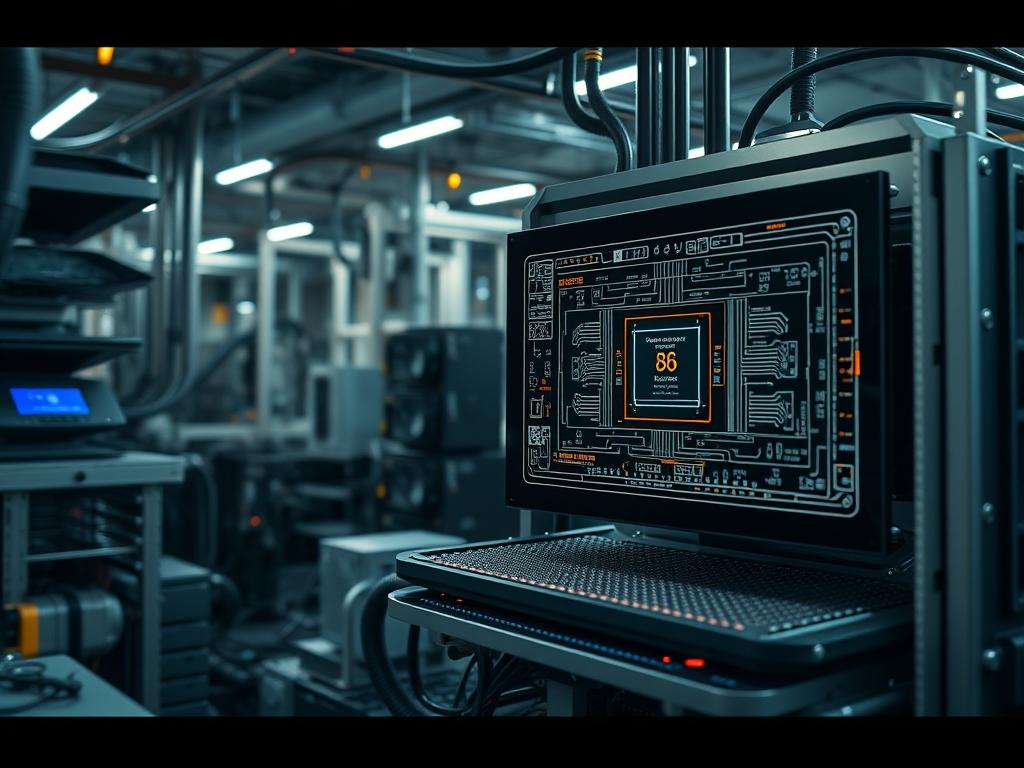
Rendering node hardware clusters represent the foundational architecture for high-density computational tasks. These systems operate as a distributed engine where raw scene data undergoes transformation into finished imagery through massive parallel processing. Within the modern technical stack; these clusters are integrated into the network infrastructure to alleviate the processing bottlenecks inherent in monolithic workstations. The “Problem-Solution” context revolves around resource exhaustion: as individual frames in a 3D environment or simulation increase in complexity, a single machine lacks the local memory and compute cycles to complete a sequence within a viable timeframe. By employing rendering node hardware clusters; organizations can distribute the computational payload across dozens or hundreds of discrete machines. This approach ensures that the systemic throughput remains constant even as the complexity of the data increases. It effectively moves the processing burden from a single point of failure to a redundant; high-performance grid; ensuring that deadlines are met through horizontal scaling rather than vertical hardware over-provisioning.
TECHNICAL SPECIFICATIONS
| Requirement | Default Port/Operating Range | Protocol/Standard | Impact Level (1-10) | Recommended Resources |
| :— | :— | :— | :— | :— |
| Node Synchronization | Port 22 (SSH) / 123 (NTP) | TCP/UDP / IEEE 1588 | 9 | 10GbE / 128GB DDR5 |
| Shared Storage Access | Port 2049 (NFS) | NFS v4.2 / NVMe-oF | 10 | NVMe Tier 0 Storage |
| Remote Management | Port 623 (IPMI) | IPMI 2.0 / Redfish | 7 | Dedicated BMC NIC |
| Inter-Node Fabric | 40Gbps – 400Gbps | InfiniBand / RoCE v2 | 8 | ConnectX-6 VPI Adapters |
| Power Delivery | 200V – 240V AC | IEC 60320 C19/C20 | 10 | 2200W Platinum PSU |
| Thermal Management | 18C – 24C (Ambient) | ASHRAE TC 9.9 | 9 | 5000+ RPM Fan Arrays |
THE CONFIGURATION PROTOCOL
Environment Prerequisites:
Successful deployment requires a standardized hardware environment and a clean software baseline. All nodes must utilize a consistent operating system; such as Ubuntu Server 22.04 LTS or Rocky Linux 9. Hardware dependencies include BIOS-level activation of VT-d and SR-IOV for virtualization tasks; as well as Re-Size BAR Support for GPU-accelerated workloads. Users must possess sudo or root level permissions across all nodes. Network infrastructure must support Jumbo Frames (MTU 9000) to minimize packet-loss and reduce the CPU overhead associated with high-frequency data transmission across the fabric.
Section A: Implementation Logic:
The engineering design of rendering node hardware clusters relies on the principle of encapsulation. Each render job is encapsulated into a discrete packet that contains the scene geometry; texture maps; and lighting shaders. The logic behind the multi-system sync is idempotent; meaning that multiple attempts to render the same frame result in the identical pixel-perfect output. The synchronization protocol ensures that all nodes share a global timestamp. This prevents race conditions where two nodes might attempt to write to the same output file simultaneously. By decoupling the compute power (the node) from the permanent storage (the NAS/SAN); we reduce signal-attenuation and I/O wait times; allowing the CPU/GPU to maintain high occupancy levels.
Step-By-Step Execution
1. High-Speed Network Interface Bonding
Apply a LACP (802.3ad) bond to the primary network interfaces via netplan or nmcli.
sudo nano /etc/netplan/01-netcfg.yaml
Insert the bond configuration specifying mode: 802.3ad and transmit-hash-policy: layer3+4.
System Note:
This action combines multiple physical links into a single logical channel; increasing the total throughput and providing redundancy. At the kernel level; the bonding driver handles the distribution of packets; ensuring that heavy payloads do not saturate a single physical link and cause latency spikes.
2. Time Synchronization via Precision Time Protocol (PTP)
Install and configure the chrony or ptp4l service to harmonize the system clocks across the cluster.
sudo apt-get install chrony
sudo systemctl enable –now chrony
Edit /etc/chrony/chrony.conf to point to a local Stratum-1 time source.
System Note:
Precise timing is critical for frame-sequencing. If a node clock drifts; the render manager may falsely flag a task as timed out or mismanage the timestamp of the output file. The chronyd service adjusts the system clock frequency at the hardware level to eliminate jitter.
3. Mounting the Distributed File System
Mount the global asset repository using high-performance flags in the fstab file.
sudo mount -t nfs -o rw,nfsvers=4.2,rsize=1048576,wsize=1048576,hard,proto=tcp
System Note:
By specifying a large rsize and wsize; we maximize the payload size for each network transaction. This significantly reduces the overhead on the network stack when nodes are pulling large texture caches or writing high-bit-depth EXR files.
4. GPU Resource Isolation and Driver Deployment
Deploy the proprietary drivers and initialize the compute fabric using nvidia-smi or individual logic-controllers.
sudo ubuntu-drivers autoinstall
nvidia-smi -pm 1
nvidia-smi -pl 300 (Set power limit to 300W for thermal stability).
System Note:
Setting the persistence mode to 1 ensures the driver remains loaded even when no applications are using the GPU; preventing a latency delay when a new render task begins. Controlling the power limit manages the thermal-inertia of the rack; preventing localized hotspots.
5. Cluster Management via Docker Swarm or Kubernetes
Initialize the cluster orchestration layer to manage containerized render engines.
docker swarm init –advertise-addr
docker node ls
System Note:
The orchestration layer handles the distribution of render containers across the nodes. It monitors the health of the dockerd service and restarts tasks on adjacent nodes if a hardware failure is detected; providing a self-healing infrastructure.
Section B: Dependency Fault-Lines:
The most common failures in rendering node hardware clusters occur at the intersection of network and storage. A mismatched MTU size between the switch and the node will result in fragmented packets and severe packet-loss; leading to “Broken Pipe” errors during data transfer. Another bottleneck is the “Initial Ramdisk overfill”; where the system attempts to load massive scene files into RAM that exceeds the physical capacity; triggering the OOM (Out Of Memory) killer in the Linux kernel. Always verify that swap is disabled or prioritized correctly to avoid a performance death spiral when memory limits are reached.
THE TROUBLESHOOTING MATRIX
Section C: Logs & Debugging:
The first point of audit during a node failure is the kernel log found at /var/log/kern.log or the systemd journal accessed via journalctl -xe. Look for “ECC Uncorrectable Error” or “PCIe Bus Error” strings to identify physical hardware degradation.
If a node drops from the cluster unexpectedly; check for signal-attenuation on the fiber links using a fluke-multimeter or by checking the SFP diagnostics:
ethtool -m
This command provides real-time optical power levels. Low RX power often indicates a damaged fiber patch cable or a failing transceiver.
For software-side rendering errors; examine the specific engine logs (e.g., V-Ray, Arnold, or Redshift logs) usually located in /tmp/ or a specified project directory. If the error code 137 appears in your container logs; this is a definitive indicator of an OOM event. You must either optimize the scene or upgrade the RAM modules on the affected hardware.
OPTIMIZATION & HARDENING
Performance Tuning:
To achieve maximum concurrency; fine-tune the kernel scheduler. Use tuned-adm to apply the throughput-performance profile. This set of optimizations adjusts the sysctl variables for disk I/O and network buffer sizes to favor sustained high-load tasks over low-latency responsiveness. Adjust the swappiness variable to 10 via sysctl -w vm.swappiness=10 to ensure the kernel prioritizes physical memory over slow disk-based virtual memory.
Security Hardening:
Node clusters often run on trusted internal networks; but they must still be hardened against lateral movement. Implement iptables or ufw rules that only allow traffic on the specific ports required for the render manager and storage.
sudo ufw allow from
sudo ufw deny from any to any
Furthermore; ensure that all remote management (IPMI/BMC) is on a strictly isolated VLAN with no external internet access to prevent firmware-level exploits.
Scaling Logic:
Scaling rendering node hardware clusters follow a horizontal growth pattern. As the demand for compute increases; add nodes to the existing Docker Swarm or Kubernetes cluster. Use a PXE (Preboot Execution Environment) server to automate the “Zero-Touch” installation of new nodes. This ensures that every new machine added to the rack is an idempotent copy of the original; with identical libraries and driver versions; maintaining systemic stability.
THE ADMIN DESK
How do I identify a “Zombie” render node?
Run ps aux | grep
Why is one node rendering significantly slower?
Check for thermal throttling using sensors or nvidia-smi. High thermal-inertia in the rack can cause a CPU or GPU to downclock its frequency to prevent hardware damage. Improve localized airflow or replace the thermal interface material.
What causes “Missing Texture” errors on certain nodes?
This is often a synchronization issue with the local asset cache. Ensure the network mount is consistent across all nodes by running ls -la /mnt/render_assets on each machine to verify directory permissions and file availability.
Can I mix different GPU models in one cluster?
While possible via heterogeneous scheduling; it is not recommended. Disparate hardware leads to uneven frame completion times and complicated resource allocation logic. Aim for identical hardware footprints to ensure predictable throughput across the entire cluster.