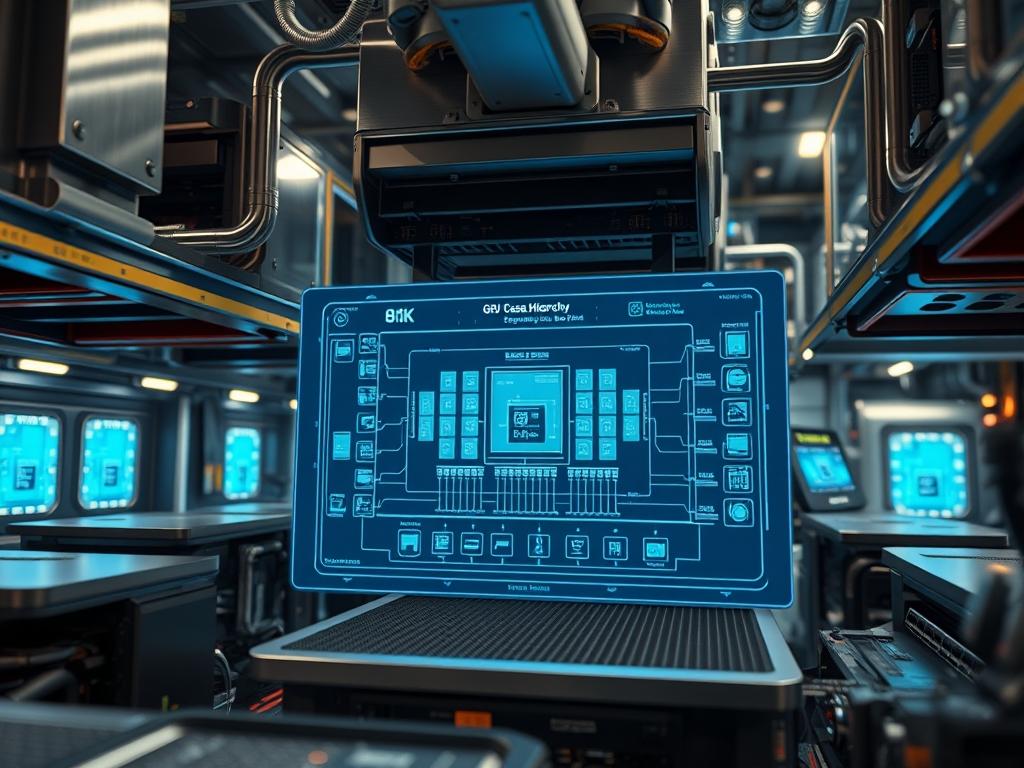
Modern gpu cache hierarchy serves as the critical intermediary between the massive parallel computing capacity of a GPU and the relatively slow throughput of external High Bandwidth Memory (HBM). In the context of large-scale cloud infrastructure and high-performance computing (HPC) clusters; the efficiency of this hierarchy determines the overall system energy footprint and the economic viability of AI-scale workloads. The primary technical challenge involves the “Memory Wall”: the widening gap between the speed of arithmetic logic units (ALUs) and the latency of data retrieval.
A robust gpu cache hierarchy addresses this by implementing a non-uniform memory access (NUMA) inspired architecture within a single silicon die. This system manages thousands of concurrent threads via a multi-tiered strategy. Registers provide the lowest latency; followed by L1 cache and Shared Memory; then a larger unified L2 cache; and finally the global HBM. Effective management of this stack ensures that data payloads are encapsulated and moved with minimal overhead; reducing the signal-attenuation issues inherent in high-frequency data transmission across long traces on a printed circuit board (PCB).
Technical Specifications
| Requirement | Default Operating Range | Protocol/Standard | Impact Level | Recommended Resources |
| :— | :— | :— | :— | :— |
| L1 Cache / Shared Memory | 32 KB – 228 KB per SM | NVLink / IEEE 754 | 10 | 80GB HBM3 / 2TB/s Bandwidth |
| L2 Cache | 40 MB – 96 MB (Unified) | PCIe Gen 5.0 | 8 | 512GB System RAM (Minimum) |
| Kernel Concurrency | 32 – 2048 Threads per Block | CUDA 12.x / ROCm 6.0 | 9 | Multi-Socket EPYC or Xeon |
| Interconnect Speed | 450 GB/s – 900 GB/s | NVLink 4.0 / CXL | 10 | Active Liquid Cooling |
| Thermal Operating Limit | 5C – 85C | PMBus / I2C | 7 | 700W+ TDP Cooling Capacity |
The Configuration Protocol
Environment Prerequisites:
Successful auditing and configuration of the gpu cache hierarchy require an environment that supports deep hardware introspection. The system must have NVIDIA CUDA Toolkit 12.x or AMD ROCm 6.0 installed; providing the necessary binary utilities for kernel profiling. At the OS level; the user must possess sudo or administrative privileges to modify hardware states via nvidia-smi or rocm-smi. Hardware requirements include a Data Center grade GPU (e.g., H100; A100; or MI300X) mounted in a PCIe Gen 5 compliant slot; ensuring that the signal-attenuation remains within operational tolerances for the high-speed bus.
Section A: Implementation Logic:
The logic behind modern gpu cache hierarchy design is built on the principle of temporal and spatial locality. The goal is to maximize the throughput by ensuring that the ALUs rarely stall while waiting for data. Registers are assigned per thread; providing instantaneous access but limited capacity. To facilitate concurrency; the Shared Memory (L1) acts as a programmable cache that allows threads within the same block to exchange data without hitting the L2 or HBM. This layer is crucial for reducing the “tail latency” of complex kernels.
Data encapsulated in L2 serves as a global synchronization point; where various Streaming Multiprocessors (SMs) can access shared data sets. By configuring the L1/Shared Memory split; an architect can tune the system for specific payload types: larger L1 for general-purpose compute or larger Shared Memory for structured data patterns. This configuration must be idempotent; ensuring that repeated applications of the same settings result in a stable; predictable performance state across a multi-node cluster.
Step-By-Step Execution
Auditing Hardware Topology and Locality
The first step involves verifying the physical and logical mapping of the GPU within the system cabinet. Execute the command nvidia-smi topo -m to generate a matrix of the GPU-to-GPU and GPU-to-CPU interconnects.
System Note: This action queries the kernel driver to identify the presence of NVLink bridges vs PCIe switches. It helps identify potential bottlenecks where the throughput might be limited by a lower-generation bus standard; which increases data movement latency.
Configuring L1 and Shared Memory Carve-out
For kernels requiring large amounts of thread-to-thread communication; the L1 cache and Shared Memory partition must be adjusted. Use the cudaDeviceSetCacheConfig function within the application code or utilize the nvidia-smi –set-gpu-memory-limit for aggregate constraints if applicable.
System Note: This command modifies the SM configuration registers; physically reallocating on-chip SRAM between the transparency of L1 and the manual control of Shared Memory. This is a hardware-level shift that affects how the load/store (LSU) units handle incoming data payloads.
Profiling Cache Hit Rates and Latency
Invoke the Nsight Compute profiler using the command ncu –metrics l1tex__t_sectors_pipe_lsu_mem_global_op_ld.sum,lts__t_sectors_srcunit_tex_op_read.sum [binary].
System Note: This targets specific hardware performance counters. It provides a direct readout of the L1 and L2 cache efficiency. High miss rates here indicate that the kernel is “cache-thrashing;” forcing the hardware to fetch data from the high-latency HBM layer; which increases the thermal-inertia of the chip due to increased power draw at the memory controllers.
Setting Persistence Modes for Stable Tuning
To ensure that configuration changes survive between kernel launches; enable persistence mode using nvidia-smi -pm 1.
System Note: This ensures that the GPU driver remains loaded in the kernel even when no active process is using the device. This prevents the hardware from resetting its power and clock management states; which can introduce jitter and unpredictable latency during high-concurrency bursts.
Section B: Dependency Fault-Lines:
The primary bottleneck in gpu cache hierarchy performance is often found in “Shared Memory Bank Conflicts.” Because shared memory is divided into banks; if multiple threads in a warp attempt to access different addresses within the same bank; the hardware serializes the requests. This creates an immediate spike in overhead. Another common fault-line is “Register Pressure.” If a kernel uses too many registers; the GPU compensates by spilling data to “Local Memory”; which is actually stored in the high-latency HBM; effectively bypassing the cache hierarchy and tanking performance.
THE TROUBLESHOOTING MATRIX
Section C: Logs & Debugging:
When performance drops; the first point of analysis should be the dmesg | grep -i nvidia output or the journalctl -u nv-persistenced logs. These logs report XID errors; which are physical fault codes from the GPU firmware. For example; an XID 61 indicates a bus-internal error often related to memory controller instability under high thermal-inertia.
If the visual cue from the profiler shows high “Stall Constant” metrics; it points to a throughput issue at the L2 level. You must verify the path-specific instructions for your architecture; often found in /usr/local/cuda/include/cuda_device_runtime_api.h. To debug signal-attenuation or bus errors; use lspci -vvv and look for the “LnkSta” (Link Status) field to ensure the GPU is negotiating at its maximum rated speed (e.g., GT/s should match PCIe Gen 5 specs).
OPTIMIZATION & HARDENING
Performance Tuning:
To maximize concurrency; optimize the “Occupancy” of each SM. This is achieved by balancing the usage of registers and shared memory. If a kernel uses 64 registers per thread; you can launch more warps than if it used 128. Use the __launch_bounds__ qualifier in your CUDA kernels to provide hints to the compiler regarding the maximum number of threads. Furthermore; utilize “Pinned Memory” (Direct Memory Access) to reduce the overhead of host-to-device transfers; ensuring that data arrives at the cache hierarchy without unnecessary CPU-side copies.
Security Hardening:
In multi-tenant cloud environments; gpu cache hierarchy can be a vector for side-channel attacks. To harden the system; ensure that MPS (Multi-Process Service) is configured with strict memory limits per user via nvidia-smi -ccc 1. Use firewall rules to block non-essential telemetry ports and ensure that the nvidia-persistenced service is running under a dedicated low-privilege user account.
Scaling Logic:
Scaling the hierarchy requires a move from single-node optimization to multi-node RDMA (Remote Direct Memory Access). By using GPUDirect RDMA; you allow the network interface card (NIC) to write directly into the GPU’s L2 cache (or HBM); bypassing the system CPU. This reduces packet-loss and signal-attenuation at the cluster level; allowing the gpu cache hierarchy to effectively extend its reach across the entire network fabric.
THE ADMIN DESK
Q1: How do I detect Shared Memory bank conflicts?
Use nsight-compute to monitor the l1tex__shared_bank_conflicts.sum metric. If the value is high; adjust your data access patterns to ensure threads in a warp access different memory banks simultaneously; minimizing serialization overhead.
Q2: What is the impact of thermal throttling on cache?
As a GPU reaches its thermal limit; it reduces clock speeds to lower thermal-inertia. This increases the latency of the L2 cache as the logic gates cycle slower; leading to a significant drop in overall memory throughput.
Q3: Can I lock the cache at a specific frequency?
Yes; use nvidia-smi -lgc [min,max] to lock the graphics clocks. This provides an idempotent environment where the cache hierarchy responds with consistent latency; which is essential for benchmarking and real-time inference tasks.
Q4: Why is my L2 hit rate lower than expected?
This usually occurs when the working set of your data exceeds the L2 capacity. Consider “tiling” your algorithms; a technique where you break large data payloads into smaller chunks that fit entirely within the L2 or Shared Memory tiers.
Q5: Does ECC impact cache performance?
Enabling Error Correcting Code (ECC) on GPU memory introduces a small performance overhead (typically 2 to 5 percent). This is due to the additional bits required for parity and the logic needed to verify data integrity during every load/store operation.