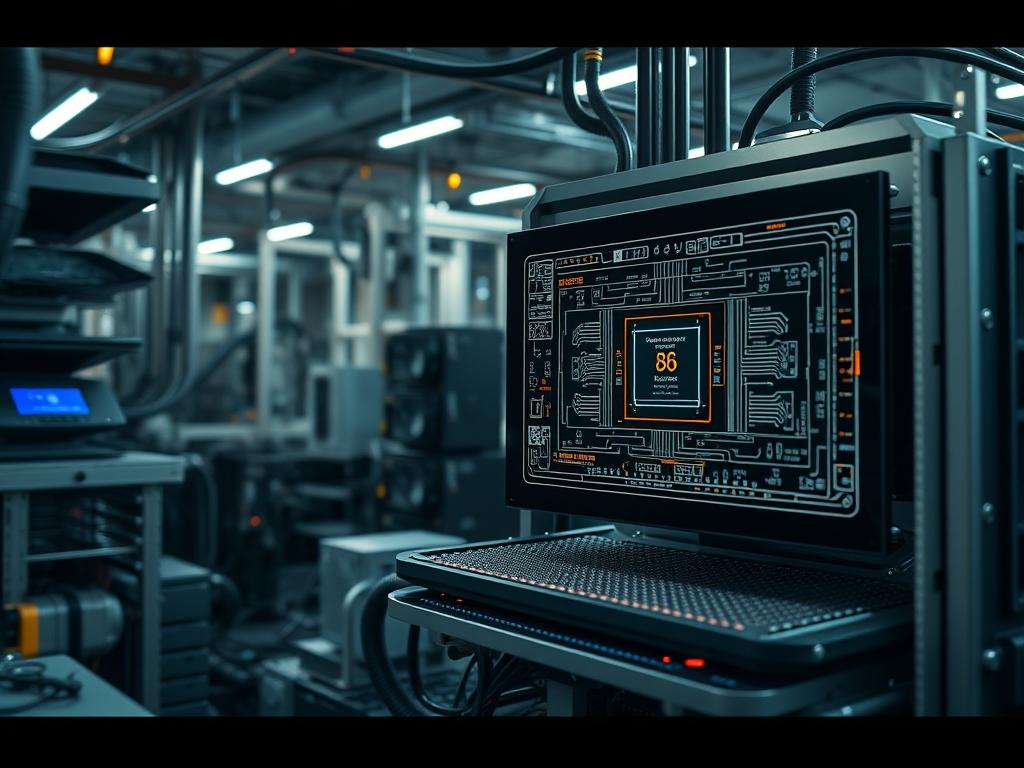
Monolithic cpu design represents the traditional pinnacle of high-performance semiconductor architecture; it integrates all computational cores, memory controllers, and I/O interfaces onto a single, continuous silicon die. Within the broader technical stack of cloud infrastructure and network edge computing, this design paradigm is chosen primarily to minimize signal latency and maximize throughput between functional units. Because the signals do not need to traverse an organic substrate or interposer as found in chiplet-based designs, the signal-attenuation is significantly reduced. This results in superior performance for real-time data processing and high-frequency trading platforms where microsecond delays are unacceptable. However, the consolidation of high-performance logic into a small physical area creates a profound engineering challenge: extreme thermal density. In a monolithic cpu design, the heat generated by one core rapidly influences the thermal state of adjacent cores through the silicon lattice. This manual provides the technical framework for managing these thermal distribution properties to ensure operational stability and to prevent the degradation of concurrency during high-load scenarios. Effectively managing this thermal-inertia is critical for maintaining the longevity of the infrastructure assets and ensuring that the payload delivery remains consistent across the network fabric.
TECHNICAL SPECIFICATIONS
| Requirement | Default Port/Operating Range | Protocol/Standard | Impact Level (1-10) | Recommended Resources |
| :— | :— | :— | :— | :— |
| Thermal Dissipation | 65W to 280W TDP | JEDEC JESD51 | 9 | High-Density Cold-Plate |
| Interconnect Latency | 0.5ns to 2.0ns | Intra-Die Bus | 7 | Cache-Coherent Mesh |
| Max Operating Temp | 85C to 105C T-Junction | IEEE 1149.1 (JTAG) | 10 | Liquid Nitrogen/Phase Change |
| Monitoring Interface | I2C / SMBus | PECI 3.0 | 8 | BMC / IPMI Controller |
| Voltage Regulation | 0.8V to 1.45V Vcore | VRM 13.0/14.0 | 9 | Solid Polymer Capacitors |
THE CONFIGURATION PROTOCOL
Environment Prerequisites:
1. Kernel requirements: Linux kernel version 5.15 or higher to support advanced ACPI power states and high-resolution thermal reporting.
2. Hardware permissions: Access to the root account or sudo privileges for modifying MSR (Model Specific Registers).
3. Software dependencies: Installation of lm-sensors, cpupower, and stress-ng for thermal load simulation.
4. Physical standards: Compliance with NEC Class 2 circuits for external cooling pump power delivery and IEEE 1149.7 for advanced debugging.
5. Material readiness: Thermal Interface Material (TIM) with a thermal conductivity rating of at least 12.5 W/mK to bridge the gap between the IHS (Integrated Heat Spreader) and the thermal solution.
Section A: Implementation Logic:
The fundamental logic behind managing a monolithic cpu design involves addressing the spatial concentration of heat. In non-monolithic systems, logical units are physically separated; this provides a natural thermal buffer. In a monolithic environment, the silicon acts as a unified heat sink. The thermal-inertia of the die means that once a specific temperature delta is reached, cooling the system back to an idle state takes longer than in modular designs. We utilize idempotent configuration scripts to ensure that thermal limits are consistently applied across thousands of nodes in a cloud cluster. This logic ensures that no single core reaches a runaway thermal state that could cause packet-loss at the network interface level or trigger a hard system reset. By managing the thermal envelope at the micro-architecture level, we preserve the high throughput capacity of the monolithic cpu design without succumbing to the limitations of localized hotspots.
Step-By-Step Execution
1. Initialize Thermal Subsystem Probing
Execute the command sensors-detect –auto to identify all on-die thermal sensors and discrete motherboard controllers.
System Note: This action causes the kernel to probe the I2C and SMBus headers; it populates the /sys/class/thermal/ directory with hardware-specific symlinks. This is the primary data source for the thermal management daemon.
2. Configure CPU Frequency Governor
Run cpupower -c all frequency-set -g performance to lock the CPU into its peak clock state for baseline benchmarking.
System Note: By modifying the acpi-cpufreq or intel_pstate driver parameters, the kernel disables aggressive power-saving C-states. This stabilizes the voltage across the monolithic cpu design, allowing for a more accurate reading of the heat generated by the logic gates rather than the power-management overhead.
3. Establish Thermal Reporting Intervals
Edit the configuration file at /etc/default/telegraf or your local monitoring agent to set the measurement interval to 100ms.
System Note: High-frequency polling of the PECI (Platform Environment Control Interface) is necessary because a monolithic die can experience localized temperature spikes of 20C within a few milliseconds. Accurate telemetry prevents late-action throttling which increases latency.
4. Stress Test and Heat Map Generation
Launch a high-concurrency floating-point workload using stress-ng –cpu 0 –cpu-method matrixprod –timeout 600s.
System Note: This command saturates the Execution Units (EUs) and the Load/Store buffers within the monolithic die. The kernel scheduler will distribute the payload across all logical cores, allowing you to observe how the thermal-inertia builds up across the unified silicon area.
5. Monitor Thermal Throttle Events
Use the command watch -n 1 “dmesg | grep -i ‘thermal'” to catch real-time hardware alerts.
System Note: When the T-Junction temperature is exceeded, the hardware sends a high-priority interrupt to the kernel. Seeing “CPU thermal throttling” in the logs indicates that the design has reached its maximum heat dissipation capacity and is now sacrificing throughput to prevent physical damage.
Section B: Dependency Fault-Lines:
The primary bottleneck in monolithic cpu design thermal management is the encapsulation layer. If the IHS is not perfectly flat, air gaps cause significant signal-attenuation in the thermal transfer process. Another major fault-line is the dependency on the VRM (Voltage Regulator Module) cooling. Because a monolithic die draws massive current in a localized area, the VRMs may overheat before the CPU does. This creates a hidden failure point where the CPU throttles not because of its internal temperature, but because the motherboard power delivery system has entered a protective state. Furthermore, outdated BIOS/UEFI versions may lack the correct microcode to interpret the thermal offset of newer monolithic revisions, leading to “ghost” overheating reports or, conversely, a failure to throttle when necessary.
THE TROUBLESHOOTING MATRIX
Section C: Logs & Debugging:
When diagnosing thermal failures in a monolithic cpu design, begin by checking /var/log/mcelog. This log tracks Machine Check Exceptions, which are often the first sign of silicon instability due to heat. If you see “Processor Heat Pipe Failure” or “Internal Timer Error”, these are specific indicators that the clock distribution network in the monolithic die is failing due to thermal expansion.
Path-specific verification:
1. Check /sys/devices/system/cpu/cpu*/thermal_throttle/ for a count of how many times each core has tripped the thermal limit.
2. Verify the fan curves via the ipmitool sensor list command. If the RPM does not increase as the temperature crosses the 75C threshold, the BMC logic is decoupled from the OS thermal state.
3. Inspect /proc/cpuinfo to ensure the “flags” section includes dts (Digital Thermal Sensor) and ht (Hyper-Threading). If these are missing, the kernel cannot properly manage the concurrency of the thermal load.
Visual Cues:
A steady rise in temperature followed by a sudden, jagged drop in clock speed indicates aggressive thermal throttling. A flat-line temperature at exactly 99C or 100C suggests the sensor has reached its reporting ceiling and the hardware is likely in a critical state.
OPTIMIZATION & HARDENING
Performance Tuning:
To maximize the efficiency of a monolithic cpu design, implement core pinning or affinity settings using taskset. By isolating high-intensity threads to cores located on the edges of the die, you can utilize the larger surface area for heat dissipation. This reduces the thermal cross-talk between cores and maintains higher throughput for the most critical tasks. Additionally, adjusting the Uncore frequency can reduce the heat generated by the shared L3 cache and memory controller, providing more thermal headroom for the primary compute cores.
Security Hardening:
Thermal Side-Channel attacks are a known risk in high-density monolithic designs. An attacker can infer the type of data being processed by measuring the minute fluctuations in the die temperature. To harden the system, implement “Thermal Noise” by randomly fluctuating the fan speeds or applying a jitter to the clock frequency. Ensure that the sensitive thermal files in /sys/class/thermal/ are set to chmod 400 so that only the monitoring service can access them. This prevents unprivileged users from mapping the thermal characteristics of the silicon.
Scaling Logic:
In a multi-node infrastructure, scaling should be based on “Thermal Orchestration”. Rather than scaling purely on CPU utilization, use thermal headroom as the primary metric. If a node in a monolithic cpu design cluster reaches 80% of its thermal budget, move the payload to a cooler node even if the CPU utilization is low. This proactive approach prevents the cluster from hitting a thermal wall where all nodes throttle simultaneously, which would cause a massive spike in global latency.
THE ADMIN DESK
How do I identify a thermal bottleneck quickly?
Run mpstat -P ALL 1. If one core shows 100% usage while others are idle, but all cores show high temperatures, you have a thermal bleed issue typical of monolithic cpu design. The heat is migrating across the silicon lattice.
What is the “Idempotent Thermal State”?
It is a configuration where the cooling response is identical every time a specific temperature is reached. This is achieved by locking the PWM fan controllers to a specific curve in the BIOS, preventing software overrides from causing inconsistent cooling.
Can I undervolt a monolithic CPU safely?
Yes, undervolting reduces the thermal overhead without impacting throughput. Use the intel-undervolt or amdctl tool to lower the Vcore offset in 10mV increments. Always verify stability with a 24-hour stress test to ensure no packet-loss occurs.
Why does my monolithic CPU throttle at 90C?
This is often due to the Prochot signal. In a monolithic cpu design, if the core reaches a specific temperature, it sends a signal to the VRM to drop the current. Check your motherboard’s thermal limit settings in the UEFI menu.
How does thermal-inertia affect my database?
High thermal-inertia means that after a heavy query load, the CPU stays hot longer. This can lead to a period of reduced concurrency for subsequent queries as the system struggles to shed the accumulated heat from the single silicon die.